
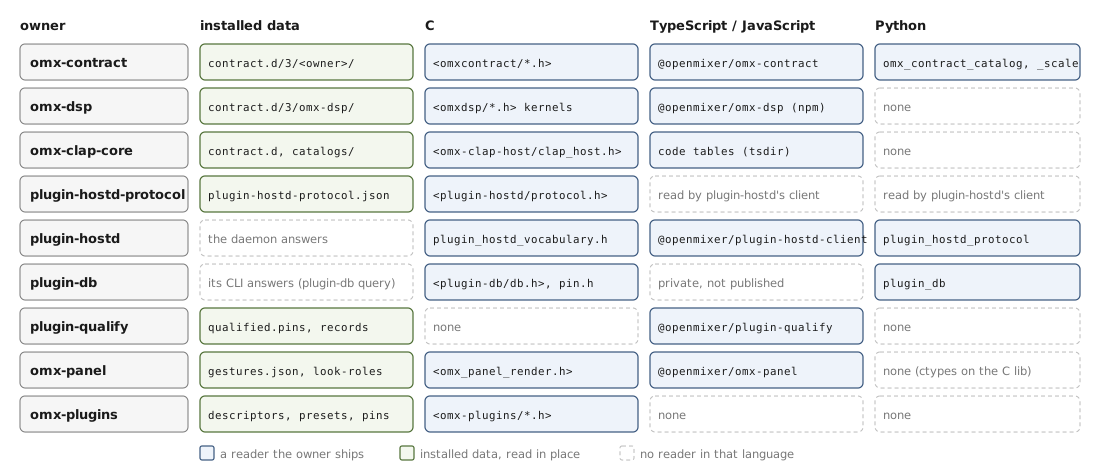
Each piece of OpenMixer writes one kind of data: omx-contract the vocabulary and the scales, plugin-hostd's protocol the words of the wire, plugin-db and plugin-qualify the records and the pins, omx-panel the layouts, omx-plugins the descriptors and presets of its own plugins. Each one also ships the reader of what it writes. A program that shows a plugin, as Zynthian's interface does, reads through those readers and keeps no copy of its own.
This note lists them, per owner and per language: what to install, the entry point, and one call. Every call below is copied from the owner's repository, with the file and line it comes from. Where the repository has no example, the note says so rather than make one up.
The packages are named rpm first, then deb. Every dependency between these packages states a floor and a ceiling, the
next minor below 1.0 and < 4 for omx-contract; the rule is written down once, in plugin-hostd's
tests/clap_core_floor.py.
omx-contract
The vocabulary, the units and scales, and the contract directory every other owner installs its words into.
| language | install | entry point |
|---|---|---|
| C | omx-contract-devel / libomx-contract-dev |
<omxcontract/omx_contract_limits.h> and the other headers under /usr/include/omxcontract/ |
| data | omx-contract-data |
/usr/share/omx-contract/, the contract directory contract.d/3/<owner>/ |
| Python | omx-contract-data |
omx_contract_catalog.py, omx_contract_scale.py in /usr/share/omx-contract/, loaded by path |
| TypeScript | npm @openmixer/omx-contract |
/catalog, /scale, /descriptor, /validate |
C, from the README (README.md:31,35):
#include <omxcontract/omx_contract_limits.h>
cc -c app.c $(pkg-config --cflags omx-contract)
A catalog sentence in TypeScript, from test/catalog.test.mjs:65-66:
const ca = loadCatalog('omx-contract', 'ca', root);
assert.equal(fill(sentenceOf(ca, CODE, 'No contract directory at {path}'), { path: '/x' }), 'Cap directori de contracte a /x');
A position on a scale, from test/scale-position.test.mjs:52-53:
const travel = { scale: 'log', min: 20, max: 20000 };
assert.equal(scalePosition(travel, 1000).toFixed(4), '0.5663');
The Python modules are not on sys.path: a program loads them by their file. plugin-db does it for the catalog reader,
in python/plugin_db/text.py:28,35-37:
READER = _installed("share", "omx-contract", "omx_contract_catalog.py")
        spec = importlib.util.spec_from_file_location("omx_contract_catalog", READER)
        _reader = importlib.util.module_from_spec(spec)
        spec.loader.exec_module(_reader)
and omx-contract's own test reads the scale that way, in test/scale-position-py.test.mjs:121-122:
t = {"scale": "log", "min": 20, "max": 20000}
print(m["scale_position"](t, 20))
Overriding a descriptor, from test/descriptor-export.test.mjs:9,17:
import { applyOverride } from '@openmixer/omx-contract/descriptor';
const r = applyOverride(read('examples/descriptors/scanned-clap-unknown.json'), [read('test/fixtures/overrides/good.json')], { paramsFingerprint: '5f0c' });
/validate and the generated omx_contract.py (CLAP_IDS, CLAP_NUMBERS): no example in the repository.
omx-dsp
The DSP kernels, and their TypeScript twins for drawing what a kernel does.
| language | install | entry point |
|---|---|---|
| C | omx-dsp-devel / libomxdsp-dev |
<omxdsp/omxdsp.h>, omxdsp/{fx,analysis,mix}/*.h: static inline kernels |
| TypeScript | npm @openmixer/omx-dsp (npm only) |
dbToLinearGain, linearGainToDb, biquadMagnitudeDb, curvePoints, the meter views |
C, from the README (README.md:32,36-37):
#include <omxdsp/fx/omx_delay.h>
cc $(pkg-config --cflags omxdsp) -c my_plugin.c
cc -shared -o my_plugin.so my_plugin.o $(pkg-config --libs omxdsp)
A twin, from ts/test/agreement.test.mjs:70:
assert.equal(linearGainToDb(0), -Infinity);
omx-clap-core
The CLAP host library, the LV2 adapter, and the tables of its codes for a program in JavaScript.
| language | install | entry point |
|---|---|---|
| C | omx-clap-core + -devel / libomx-clap-core1 + -dev |
<omx-clap-host/clap_host.h>: omx_clap_host_config_default, omx_clap_host_configure, omx_clap_host_open, omx_clap_host_activate, omx_clap_host_close |
| C, LV2 | omx-clap-lv2-devel / libomx-clap-lv2-dev |
<omx_clap_lv2.h> |
| JavaScript | omx-clap-core / libomx-clap-core1 |
omx-clap-core-vocabulary.js, omx-clap-core-hosting.js in pkg-config --variable=tsdir omx-clap-core |
From tests/active_race_test.c:66-68,77,83:
    omx_clap_host_config_default(&config);
    config.lane_channels = 0;
    if (omx_clap_host_configure(&config) != 0 || omx_clap_host_open(argv[1], STEREO_MONO, &in, why) != 0 || !in)
    // …
        if (omx_clap_host_activate(in, SAMPLE_RATE, BLOCK, why) != 0)
    // …
    omx_clap_host_close(in);
The JavaScript tables have no example in the repository; plugin-qualify reads them in its tools/clap-core-tsdir.mjs.
plugin-hostd-protocol
The words of the wire, as a C header and as the table both clients read.
| language | install | entry point |
|---|---|---|
| C | plugin-hostd-protocol + -devel / libplugin-hostd-protocol0 + -dev |
<plugin-hostd/protocol.h>: the pin path codec phd_pin_path_encode, phd_pin_path_decode; the X-macro tables PHD_VERBS, PHD_ERRORS, PHD_EVENTS |
| data | the runtime package | /usr/share/plugin-hostd-protocol/plugin-hostd-protocol.json, the table (pkg-config --variable=table plugin-hostd-protocol) |
From tests/protocol_test.c:816:
if (phd_pin_path_decode("Surge%20xt%2c.clap", back, sizeof(back)) != 0 || strcmp(back, "Surge xt,.clap"))
plugin-hostd
The daemon's two clients, one codec over the table above.
| language | install | entry point |
|---|---|---|
| TypeScript | npm @openmixer/plugin-hostd-client (npm only) |
class Protocol: encode, decode, parse, code, name, sentence |
| Python | python3-plugin-hostd-protocol |
plugin_hostd_protocol: Protocol, with the same calls |
| C | plugin-hostd-devel / plugin-hostd-dev |
<plugin-hostd/plugin_hostd_vocabulary.h> |
TypeScript, from clients/ts/README.md:26-39:
import { Protocol } from '@openmixer/plugin-hostd-client';

const protocol = new Protocol();            // the installed table and vocabulary
// …
protocol.encode('add', ['clap:...', 0]);     // the line to send, by the table's form
// …
protocol.parse('resp 0');                     // what the host answered: a reply, feedback or a protocol error
// …
protocol.sentence(-2, 'ca');                  // its sentence in a listed language, English when the catalog lacks it
Python, from clients/python/tests/test_codec.py:10,28,58:
from plugin_hostd_protocol import RETRY_REASONS, Protocol, ProtocolError, format_number
# …
        cls.protocol = Protocol()
# …
        reply = self.protocol.parse(line)
The two clients are held to the same answers by tests/clients_agree.py.
plugin-db
The records of what each plugin is on this machine, and the verdict a surface shows.
| language | install | entry point |
|---|---|---|
| Python | python3-plugin-db |
plugin_db: query(address, here), read(entry, here), why(answer, lang), vocabulary |
| C | plugin-db-devel / plugin-db-dev |
<plugin-db/db.h>, <plugin-db/pin.h>: pdb_address_parse, pdb_state, pdb_check, pdb_word |
| command | plugin-db |
plugin-db query --json |
Python, from README.md:101-105:
from plugin_db import query, read, why, vocabulary as v

answer = query("lv2:http://example.org/plugins/amp", here)   # asks the command plugin-db
if answer["state"] == v.states.qualified: ...
why(answer, "ca")                                            # the sentence of its reason, in Catalan
C, from tests/consumer.c:11,33-35:
#include <plugin-db/db.h>
// …
    if (pdb_address_parse("lv2:http://example.org/amp", &address) != 0)
        return 1;
    printf("%s\n", pdb_word(formats, PDB_ADDRESS_FORMATS_COUNT, address.format));
Its TypeScript twin is private and not published.
plugin-qualify
The qualification records and the pins file the daemon reads.
| language | install | entry point |
|---|---|---|
| TypeScript | npm @openmixer/plugin-qualify; the plugin-qualify package carries it |
parsePinLine, pinLine; recordFigures; readDistributedLayer |
| data | plugin-qualify writes, plugin-qualification-records ships |
/var/lib/omx/qualified.pins, /var/lib/omx/qualification/, /usr/share/omx/qualification/ |
A pin line, from src/pins-file.test.ts:89:
const p = parsePinLine(pinLine(entry("clap:/p/x.clap#id", { verdict: "isolated" }))!);
A record's figures, from src/record-figures.test.ts:28:
const figures = recordFigures(rec, 48000, 128);
readDistributedLayer: no example in the repository. There is no Python reader of records or of the pins file.
omx-panel
The layout of a plugin's pages, its gestures and its looks, and the renderer that draws them.
| language | install | entry point |
|---|---|---|
| TypeScript | npm @openmixer/omx-panel; the omx-panel package carries it |
/describe: describe; /panel-description: pagesOf; /gestures; /look |
| C | omx-panel-render + -devel / libomx-panel-render0 + -dev |
<omx_panel_render.h>: omx_panel_view_create_from_files, omx_panel_word_name |
| data | omx-panel |
/usr/share/omx-panel/schema/gestures.json, schema/look-roles.json |
From test/describe.test.mjs:35 and test/pages.test.mjs:17:
  const { description, refusals } = describe(descriptor(dyn(), lv2('lv2:CompressorPlugin')));
  // …
  const eight = pagesOf(x, { perPage: 8 });
C, from renderer/src/cli.c:386:
omx_panel_view_t *v = omx_panel_view_create_from_files(desc, data, err, sizeof err);
No Python reader is shipped; the repository's test/host_reads.py reads the word names from the C library with ctypes.
omx-plugins
OpenMixer's own plugins: their descriptors, presets and pins, and the static entry of each CLAP plugin.
| language | install | entry point |
|---|---|---|
| data | omx-plugins-contract, omx-plugins |
descriptors contract.d/3/omx-plugins/plugins/<stem>.json; presets /usr/share/omx/presets/<plugin id>/<preset id>.json; pins /usr/share/plugin-hostd/pins.d/omx-plugins.pins |
| C | omx-plugins-devel / omx-plugins-dev |
<omx-plugins/omx_clap_static.h>: omx_clap_static_find; <omx-plugins/omx_preset_file.h> |
From docs/catalogue.md:690-695:
#include <omx-plugins/omx_clap_static.h>

const clap_plugin_entry_t *e = omx_clap_static_find("org.openmixer.delay");
e->init("");
const clap_plugin_factory_t *f = e->get_factory(CLAP_PLUGIN_FACTORY_ID);
const clap_plugin_t *delay = f->create_plugin(f, host, "org.openmixer.delay");
Not there yet
- plugin-qualify cites a Python reader of record figures for Zynthian (
tools/record_figures.py) that does not exist: there is no Python reader of records or of the pins file. - omx-contract's Python modules are not on
sys.path; every program loads them by their file, as plugin-db'stext.pydoes. A package is on its way,python3-omx-contract(import omx_contract.catalog). - Three kinds of name a client compares against are not constants of their owner's reader yet, so the Zynthian fork
writes them as text on a few listed lines, each naming the owner's issue: which refusals are transient
(plugin-hostd-protocol), the verbs and the reply codes in the Python client (plugin-hostd-protocol) and the grouping
reasons of
grouping.json(plugin-hostd). - omx-contract's
/validateexport, its generatedomx_contract.pyand plugin-qualify'sreadDistributedLayerhave no example in their repositories. - omx-dsp's TypeScript twins and plugin-hostd's TypeScript client are on npm only, not in the rpm or deb packages; plugin-db's TypeScript twin is private.